Shiny.DocumentDb v13 — Encryption, an Outbox, and a Front Door
On this page
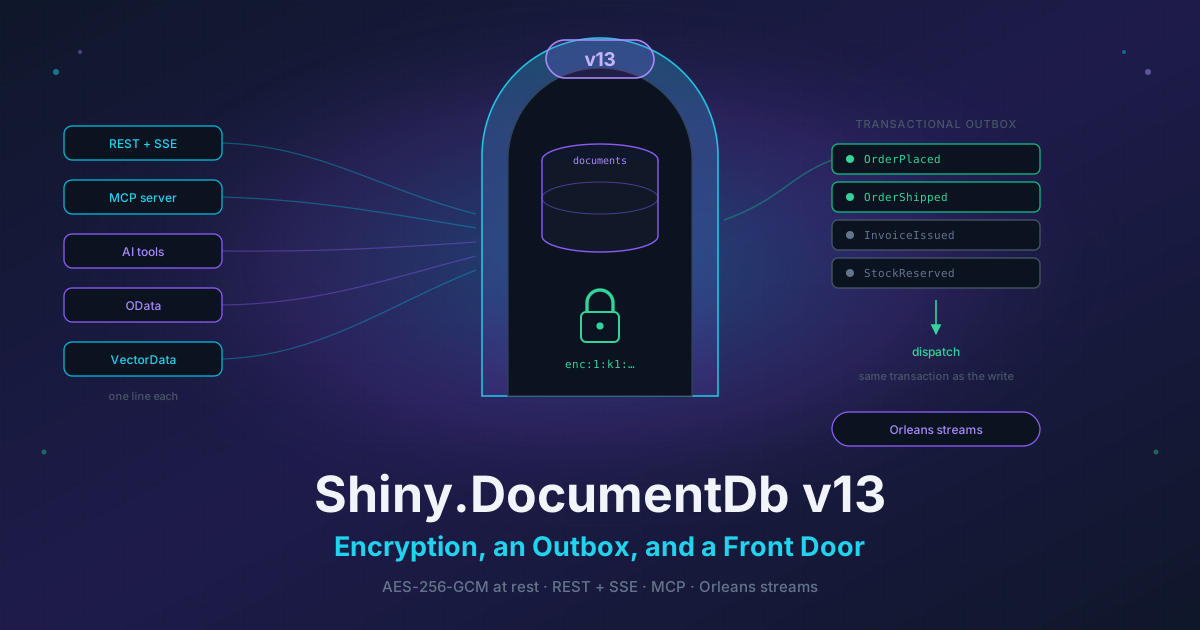
Somewhere around v10 I stopped thinking of DocumentDb as a place to put documents. v13 is where that finished happening. It’s still a document store, but the interesting work this cycle was all about the edges — what sits in front of the store, and what the store hands to something else.
You can now put an HTTP resource in front of a document type in one line. Or an MCP server, so Claude can poke at your data. Or an Orleans stream provider. Or an outbox that commits the message in the same transaction as the write that caused it. And underneath all of that, individual fields can be encrypted at rest, on every provider.
It’s a big one, so let me start with the part that’ll bite you.
The breaking one: ConfigureDocument<T>
Every flat per-type mapping method is gone. MapTypeToTable, MapIdProperty, AddQueryFilter,
MapSpatialProperty, MapVectorProperty, MapTemporal, MapBlob, OnBeforeWrite — all of them. The
type gets named once, and its whole configuration reads top to bottom:
options.ConfigureDocument<Patient>(cfg =>
{
    cfg.Table = "Patients";
    cfg.MapIdProperty(x => x.Id);
    cfg.AddSoftDelete(x => x.IsDeleted);
    cfg.MapSpatialProperty(r => r.Location);
    cfg.MapProperty(x => x.Ssn, p => p.Encrypt(EncryptionMode.Deterministic));
    cfg.MapVectorProperty(d => d.Embedding, dimensions: 1536);
    cfg.MapTemporal(o => o.Retention = TimeSpan.FromDays(90));
});
I resisted this for two versions because it’s a genuinely annoying migration for anyone with a lot of
types. What changed my mind was writing the encryption feature: the flat surface meant every options
class in every provider package needed a new method, and half of them would have been mechanical copies
of each other. The builder is written once against IDocumentStoreOptions, so every provider gets the same
surface for free, and provider packages layer their own vocabulary on top (cfg.ToContainer on Cosmos,
cfg.ToCollection on MongoDB, and so on).
There’s a full old→new table in the migration guide. It’s mostly find-and-replace.
While I was in there I added validate-on-build: one configuration sweep when the store is constructed that reports every problem at once, instead of the old one-per-restart game. It catches things the backend can’t do (a vector mapping on LiteDB) and, usefully, randomized-encrypted properties used where the database has to read through them — a full-text index, a computed expression, the concurrency version.
Field-level encryption
Whole-database encryption protects the file. It does nothing about the DBA, the backup, or the read replica. Sometimes what you actually want is “this one column is unreadable without a key”.
opts.UseEncryptor(new AesGcmDocumentEncryptor("k1", key));

opts.ConfigureDocument<Patient>(cfg =>
{
    cfg.MapProperty(x => x.Ssn, p => p.Encrypt());
    cfg.MapProperty(x => x.Email, p => p.Encrypt(EncryptionMode.Deterministic));
});
That’s the whole thing. Get, ToList, Insert, LINQ — nothing about reading or writing changes. The
stored body just holds enc:1:k1:… where the value was.
The implementation is the bit I’m pleased with. It’s installed as a JsonTypeInfo modifier, which
means every write path is covered by construction. That matters more than it sounds: the two places a
bolt-on encryption layer always forgets are temporal history and backup export, and neither of them needed
a line of code, because both go through serialization like everything else. No provider knows encryption
exists.
Deterministic mode keeps equality filters working — the predicate’s constant gets rewritten into the
ciphertext actually stored, so Where(x => x.Email == "a@b.com") still matches. The docs say in bold what
that costs: deterministic ciphertext leaks equality and frequency. Anything that can’t be answered against
ciphertext — a range, a Contains, an OrderBy — throws with an explanation instead of quietly matching
nothing, which was a deliberate choice. Silently returning zero rows is a much worse failure than an
exception.
One thing to check before upgrading. Encrypted properties now leave the library as plaintext rather
than re-encrypted envelopes. The converters are symmetric, so anything that materialized a document and
serialized it again through the store’s own options was re-encrypting what it had just decrypted — OData
responses, AI tool results, and GetDiff.
GetDiff was properly broken by this. Under randomized mode it compared the stored envelope against a
freshly-encrypted one, and the same plaintext encrypts differently every time, so every mapped property
came back as changed on every call. Embarrassing, and now fixed. But do look at your exposed OData entity
sets first — a field that used to go over the wire as an opaque string now goes over it as its value.
An outbox that actually commits with the write
The dual-write problem, for the three people who haven’t hit it: you save an order and publish
OrderPlaced. Two systems, no shared transaction. Process dies in the middle. Now you either have an order
nobody heard about, or a message about an order that doesn’t exist.
await using var session = store.OpenSession();
session.Add(order).Enqueue(new OrderPlaced(order.Id, order.Total));
await session.SaveChanges();     // both rows commit together, or neither does
Delivery is at-least-once with backoff and dead-lettering, and claiming is per-message optimistic
concurrency — so you scale workers by running more of them, with no coordinator to configure. The
traceparent from enqueue is restored at dispatch, so a consumer’s span links back to the request that
caused the message, which is the kind of thing you don’t appreciate until you’re staring at a trace at 2am.
Now the part I want to be straight about: this doesn’t ship everywhere. Relational providers and
LiteDB, and that’s it. Every other backend implements a unit of work by compensation — undo the writes
you already made — which does exactly nothing for a process that dies mid-unit. That’s the precise window
an outbox exists to close, so shipping it there would be shipping a promise that doesn’t hold. There’s a
SupportsTransactions capability now, and those backends are refused at host startup, by name.
Cosmos is a further no, and for a reason I find slightly funny: “same transaction” there means “same
logical partition”, and the store partitions by type name — so an Order and an OutboxMessage are never
in the same one. Use the change feed.
A front door
Two features, same idea: stop making people write the boring layer.
app.MapDocuments<Order>("/orders", o =>
{
    o.Operations = DocumentEndpoints.All;
    o.AllowFilterOn(x => x.Status, x => x.Total);
    o.Scope<ITenantContext>((tenant, _) => x => x.TenantId == tenant.TenantId);
})
.RequireAuthorization("orders");
List, by-id, count, create, replace, merge-patch, delete, and a live Server-Sent-Events tail. Filtering
goes through the store’s own string grammar behind a per-endpoint allowlist — an unlisted field is a
400, not a table scan, because “expose the query language over HTTP” is otherwise a great way to hand
someone a denial-of-service button.
Scope(...) is resolved per request from the request’s own DI scope, AND-ed into everything, and the
caller can’t remove it. Out-of-scope documents come back 404 rather than 403, because a 403 confirms
the row exists.
And the MCP server:
shiny-documentdb-mcp --provider sqlite --connection "Data Source=app.db"Point Claude Code or Claude Desktop at a store and let it explore. The tools are the same ones the
Extensions.AI integration uses — one implementation, one security model, which was the whole point.
Read-only by default; writes need two separate locks. No raw-SQL tool, no schema mutation, page caps,
property hiding, and an audit line per call.
The stdio tool figures out what to expose from the stored TypeName discriminators, so it needs no
compiled document classes at all. Point it at any DocumentDb database and it just works.
The admin tools, which I’ve badly under-sold
Two things here have never had a post, which is my fault.
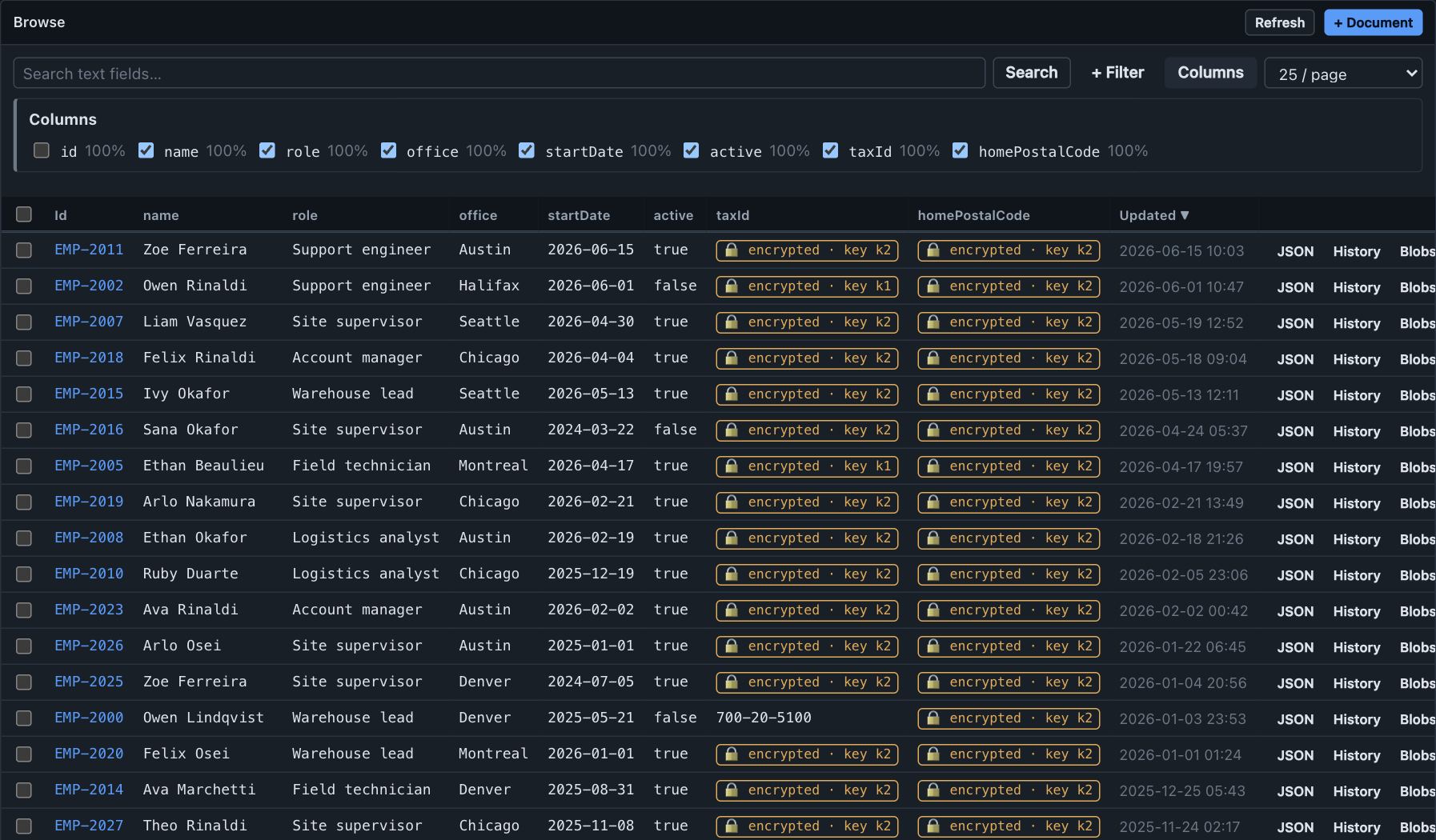
It reads an encrypted store without a key
The admin tools shipped before encryption did, so at first they knew nothing about it — an encrypted field was just a weird-looking string. Now they read the envelope, describe it, and refuse to quietly destroy it, all with no key at all.
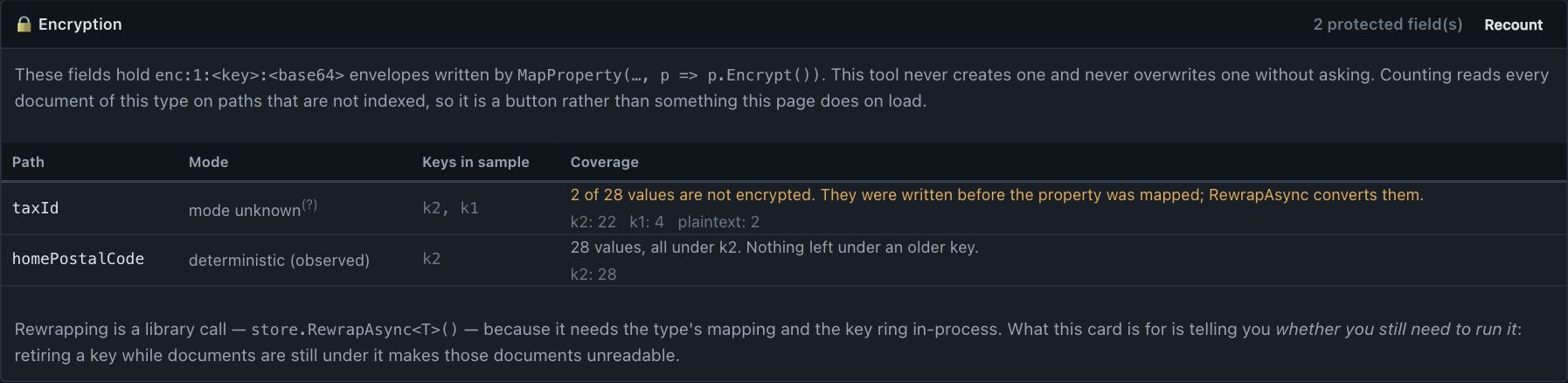
That card exists because of a specific fear. RewrapAsync<T>() moves documents onto a new key, but nothing
tells you whether it finished, and retiring a key while documents are still under it makes those
documents permanently unreadable. So the card counts how many values sit under each key id, how many are
still plaintext, and how many are under a key it’s never seen. It reports mode as deterministic (observed) only when a repeated ciphertext proves it, and never claims “randomized”, because that’s
unprovable.
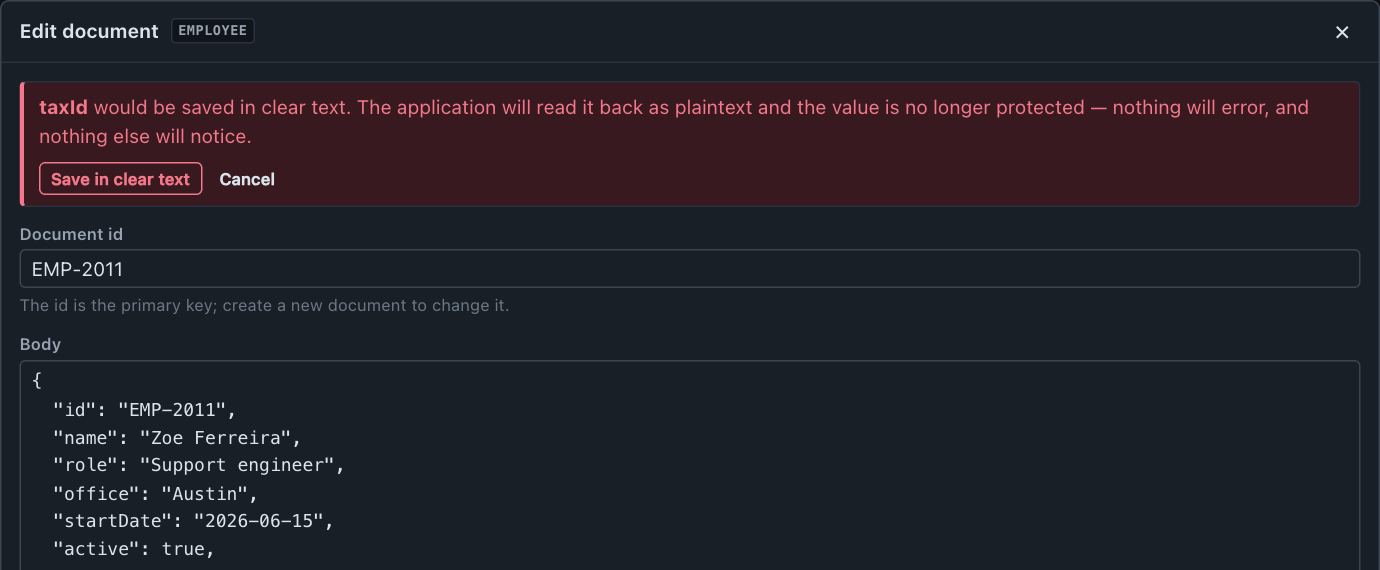
The failure this prevents isn’t an exception — the library reads a non-envelope as pre-encryption plaintext, quite deliberately, so you can turn encryption on for a populated store. Which means saving a document through the admin UI without the key would have silently un-encrypted a field, forever, with no error anywhere. Now it throws unless you say so out loud.
There’s a terminal version
This shipped in 12.5 and I never wrote it up. ShinyDocDbMyAdmin.Tui is a dotnet tool that is the same
tool as the web UI — same connection store, same screens, no browser, works over SSH.
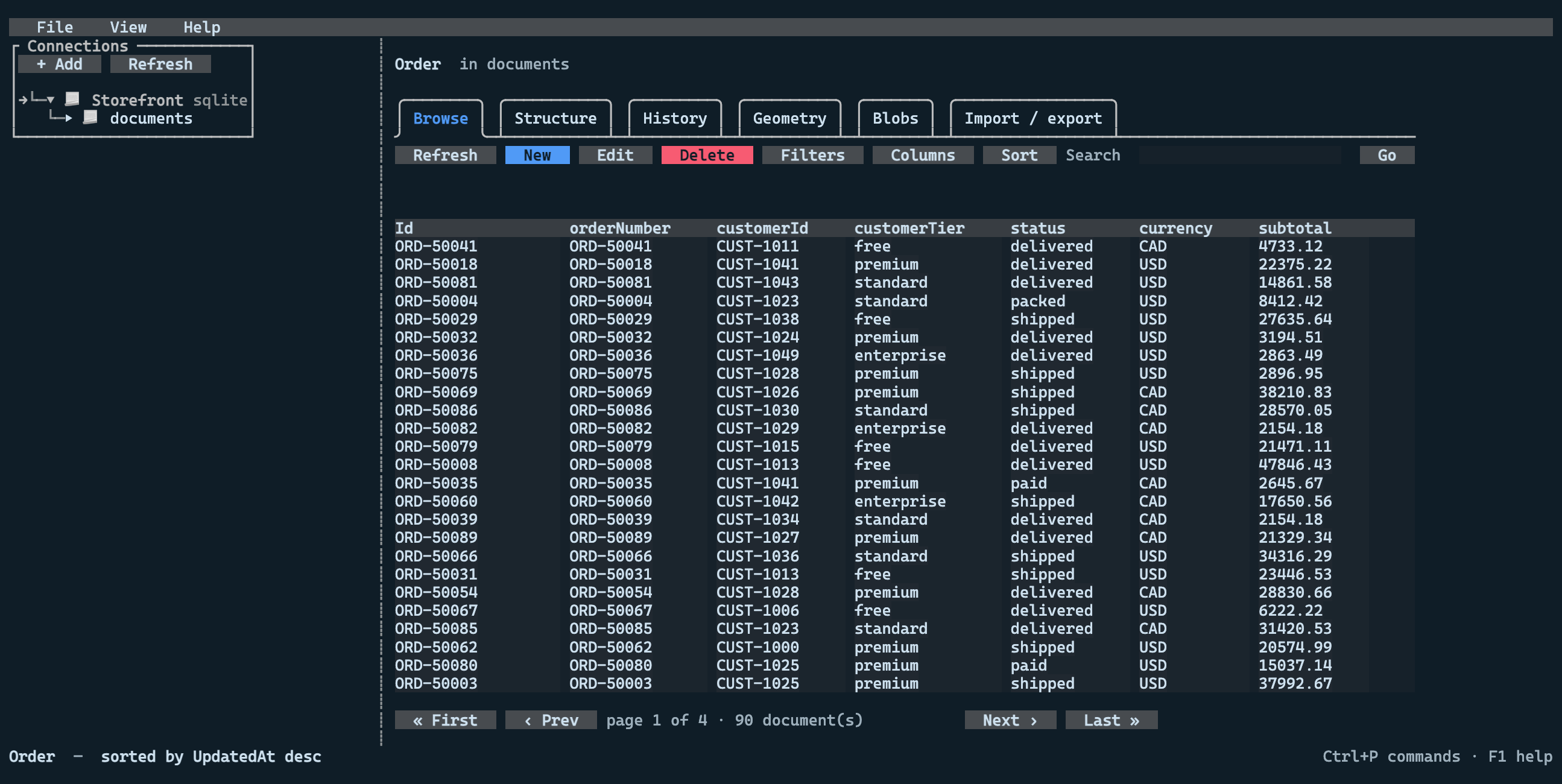
I said in the v12 post that there’d deliberately never be a dotnet tool version, because packing native
provider binaries for every RID came out around 120MB. Reader, it’s 152MB. I built it anyway, because
“I’m SSH’d into a box and want to look at the documents” turned out to be the case I hit most.
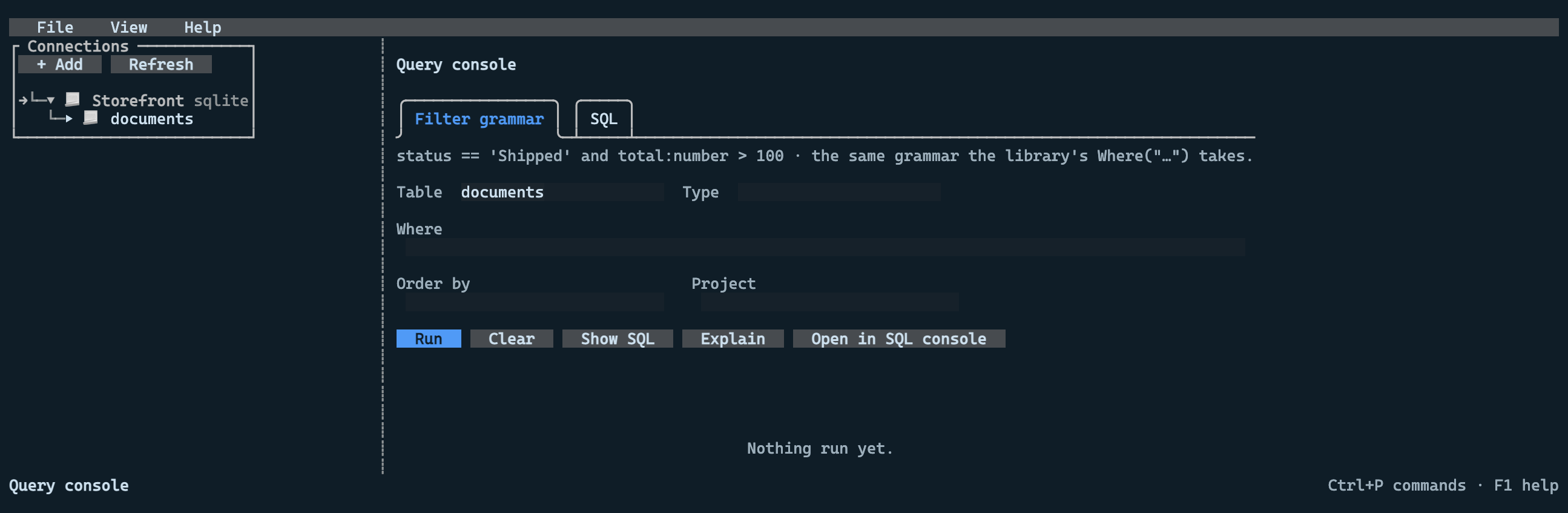
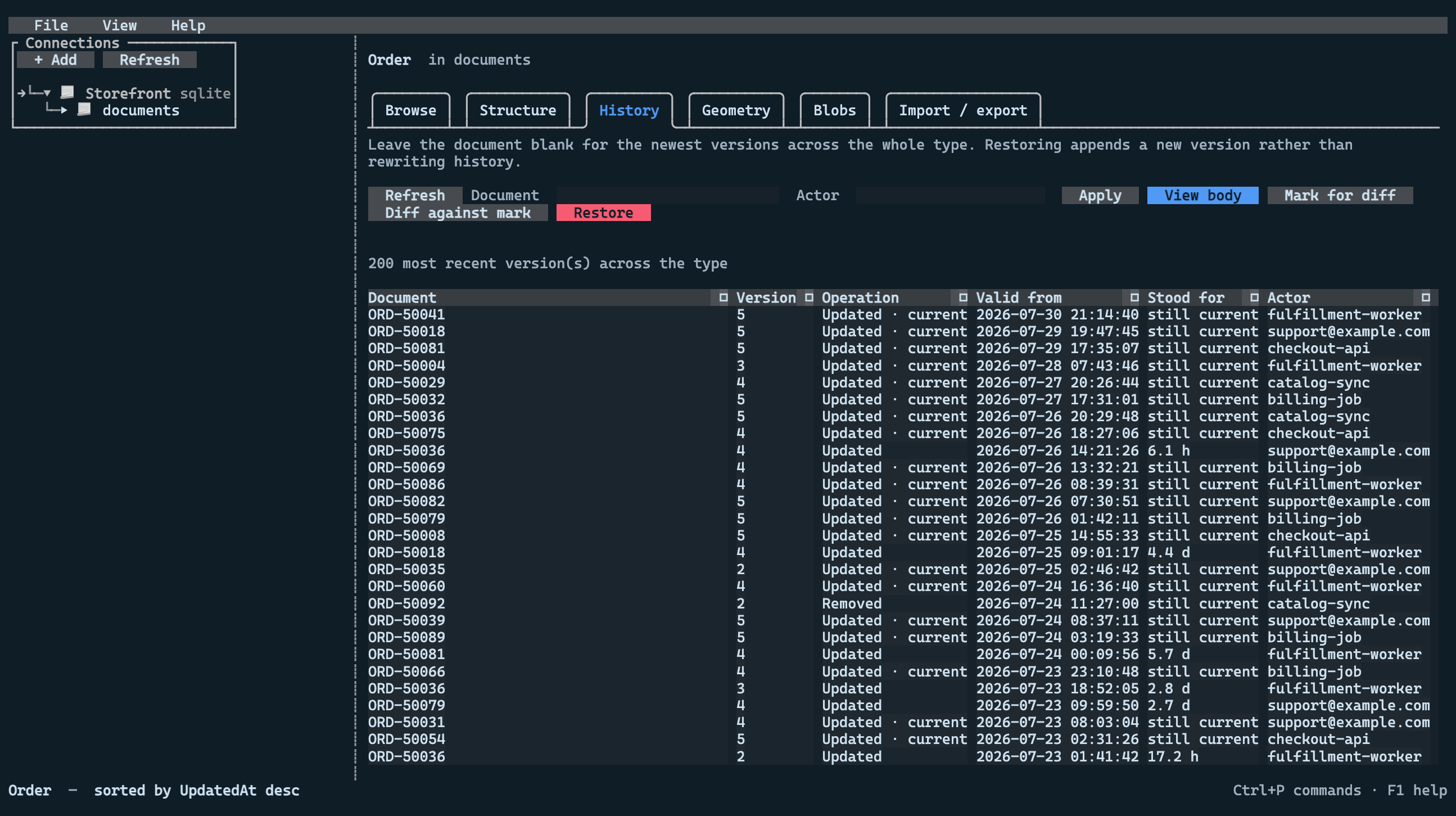
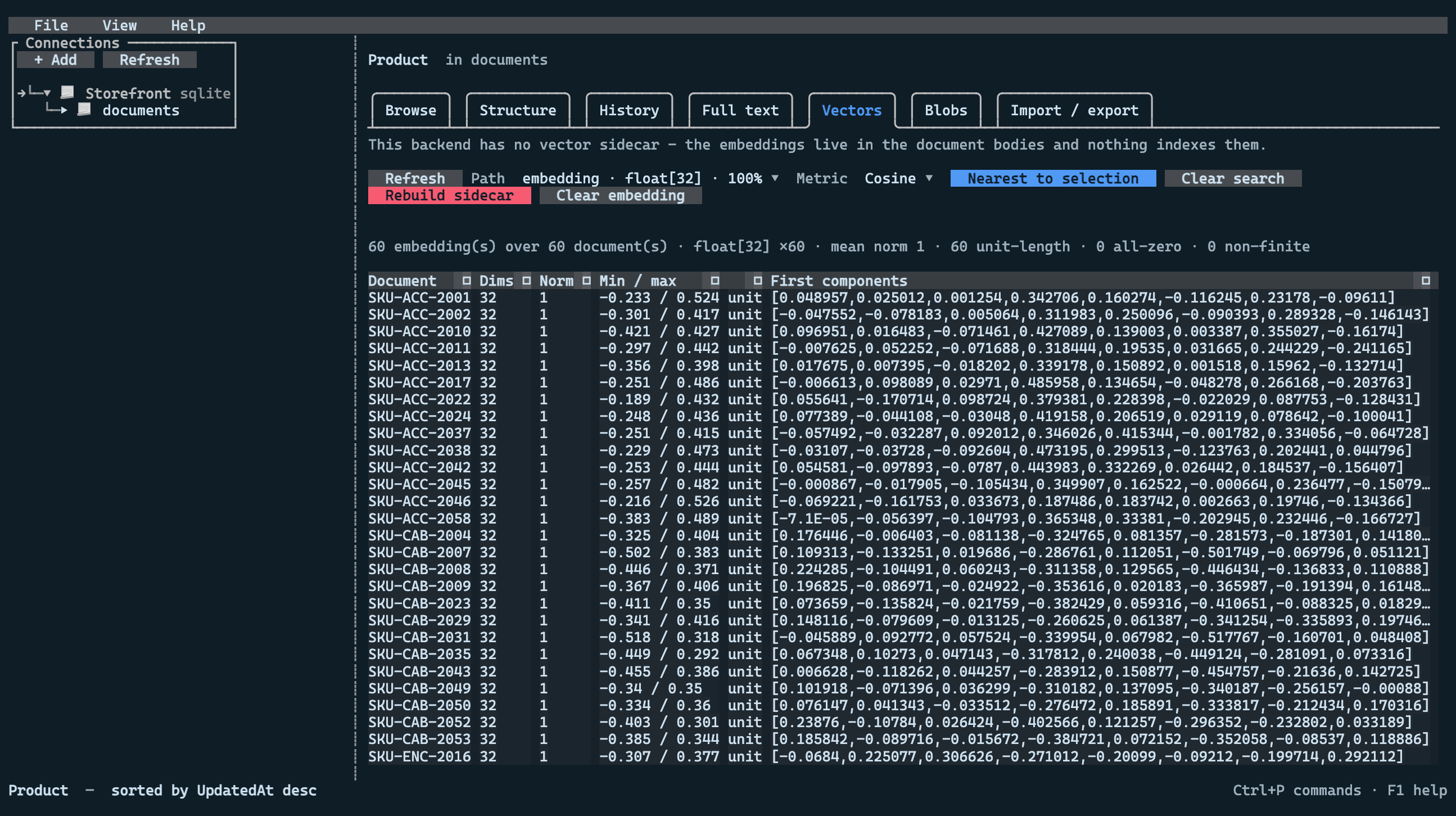
Geometry, full-text, blobs, import/export and the new outbox and streams screens are all in there too.
There’s also a Docker Desktop extension now:
docker extension install aritchie/shiny-docdb-myadmin-extensionIt adds a tab that starts the admin container and hands it every database container already running on your machine, connected — Postgres, MySQL, MariaDB, SQL Server, Oracle, CockroachDB, discovered by image with credentials read from each container’s own environment. It addresses them over the Docker network, so a database that never published a port still works.
Orleans streams, and a lock that wasn’t
13.2 added an Orleans persistent stream provider. Your cluster already uses DocumentDb for membership, grain storage and reminders — now it can use it for streams too, with no queue service to run and a backlog you can actually look at when something won’t drain.
Two decisions I’d happily defend:
No identity column for sequencing. Identity hands out values at insert time, but rows become visible at commit time — so a slow transaction can be stepped over by the receiver’s watermark and its event never delivered at all. Instead each queue has a counter row whose position is reserved under a row lock inside the enqueue transaction. Assignment order and commit order become the same order, and the sequence is gap-free.
IsRewindable is true. A subscriber can resume from a token older than anything in memory, because the
cache replays the events table instead of reporting a cache miss. No queue-backed provider can do that —
behind Azure Queue or SQS, the message is gone the moment it’s handed over.
Building that turned up something embarrassing: LockMode had never worked. It shipped validated but
inert — the API demanded an active transaction and then issued a completely ordinary read, so
session.Get(id, LockMode.Update) blocked nothing, anywhere, on any backend. It looked right in every test
that didn’t check for contention. It now emits the engine’s own syntax — FOR UPDATE, FOR SHARE,
LOCK IN SHARE MODE on MariaDB, WITH (UPDLOCK, HOLDLOCK) on SQL Server — and Oracle throws for
LockMode.Share rather than degrading to an unlocked read, because it has no shared row lock and pretending
otherwise is how you get the bug I just described.
The rest
- VectorData connector — MEVD (
VectorStore/VectorStoreCollection) over any vector-capable DocumentDb backend. Every other MEVD connector is single-store; this one lets you run SQLite on the dev box and pgvector in production off the same record model. First/Singleterminals, with predicate and string overloads, and they push the row limit down rather than materializing everything to take one.- Multi-property
ExecuteUpdate—b.Set(...).Set(...)in one atomic statement. - Raw JSON terminals — end a typed query with JSON instead of
T, so a document headed for an HTTP response never becomes an object. I wrote about these in Hidden Gems. - Multi-tenancy hardened — bounded store cache with LRU + idle eviction, any provider per tenant, and a fix for a genuinely nasty bug where the DI container disposed a tenant’s shared store at the end of the first request that touched it.
Full changelog is in the release notes.