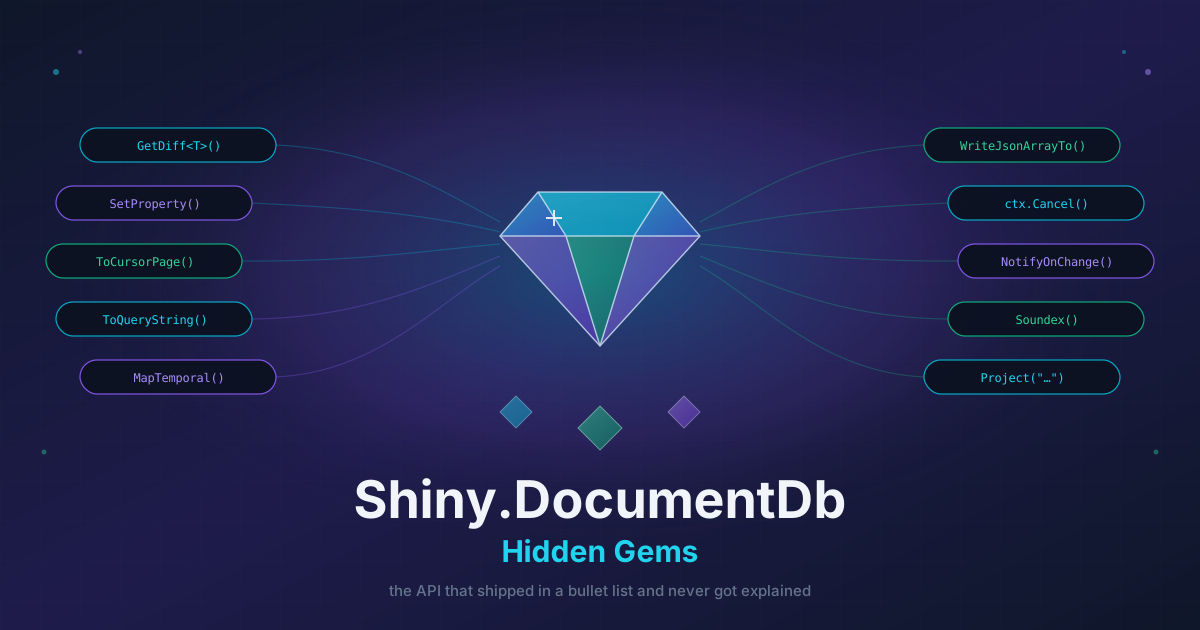
Shiny.DocumentDb — Hidden Gems
On this page
I have a bad habit with release posts. I write up the headline, list everything else in one line each, hit publish, and move on to the next release. Do that thirteen times and you end up where I am now: a library with a genuinely large surface, where a decent chunk of the good stuff has never been explained to anyone, including the people using it.
I noticed because someone asked me how to build an audit trail on top of DocumentDb. There’s a feature that does it. It’s been there since v7. It got one bullet.
So this is the sweep — the things I actually reach for, that never made a headline. Three of them get real depth because they change how you’d write the surrounding code. The rest are quick hits.
(Everything below uses the v13 spelling, where per-type configuration lives in one ConfigureDocument<T>
block. If you’re on v12, the same methods exist, just flatter.)
The store already knows what changed
You’ve got a document in the database and an object in memory that a form, a merge, or an LLM has been editing. The next question is always what actually changed? — for an audit line, a confirmation dialog, a “this touches four fields, are you sure”.
I wrote that comparer by hand more than once before I put it in the library.
var patch = await store.GetDiff<Order>(order.Id, edited);
// JsonPatchDocument<Order> — a real RFC 6902 patch. null if there's no such document.
The thing I like about it is that it’s a read. Nothing’s been written yet, so you can call it at the moment the question is actually being asked — before the save, not after it.
The write side has the same idea pointed the other way. Upsert is an RFC 7396 merge, so the properties
you didn’t set stay as they are:
await store.Upsert(new Order { Id = id, Status = "shipped" });And when it’s one field, don’t bother with the object at all:
await store.SetProperty<Order>(id, o => o.Status, "shipped");
await store.RemoveProperty<Order>(id, o => o.CancelReason);
One statement against the JSON column. No read first, so nothing to lose an update to.
And then temporal makes it faintly ridiculous
options.ConfigureDocument<Order>(cfg => cfg.MapTemporal(o => o.Retention = TimeSpan.FromDays(90)));That’s the whole setup. Now every write leaves a version behind, and:
var temporal = (ITemporalDocumentStore)store;

await temporal.History<Order>(id);                 // every version
await temporal.AsOf<Order>(id, lastTuesday);       // the document as it was
await temporal.ChangesByActor<Order>("user:42");   // everything one person touched
await temporal.GetDiffBetween<Order>(id, 3, 7);    // a patch between two versions
await temporal.Restore<Order>(id, version: 3);     // put it back
Audit trail, point-in-time read, per-user change log, undo button. One line of config, every provider.
This is the one that prompted the post, and I’ll be blunt about why: nearly everyone hand-rolls a
ChangeLog table, and a hand-rolled one only ever records the fields somebody remembered to record. This
one records the document.
Stop deserializing JSON just to serialize it again
Here’s a shape you’ve written, and so have I, a hundred times:
var order = await store.Get<Order>(id);   // JSON -> Order
return Results.Ok(order);                 // Order -> JSON
The database handed over a perfectly good JSON document. We parsed it into an object graph, allocated
every string and list inside it, then serialized it straight back into bytes that are — whitespace aside —
what we started with. Order did nothing. It was overhead wearing a type name.
DocumentDb stores JSON. So take the JSON:
var raw = await store.Query<Order>().Where(o => o.Id == id).FirstOrDefaultRawJson();
return raw is null ? Results.NotFound() : Results.Content(raw, "application/json");
For a list, don’t even build the list — stream it into the response as it comes off the reader:
ctx.Response.ContentType = "application/json";
await store.Query<Order>()
    .Where(o => o.Status == "open")
    .OrderByDescending(o => o.CreatedAt)
    .WriteJsonArrayTo(ctx.Response.Body, ct);
The bit that makes this actually usable, and the bit I’m pleased with: you still build the query with the
typed API. Where, OrderBy, Paginate, your global filters, soft delete, tenancy — all still apply,
because the only thing that changed is the terminal. Compiler checks your predicate; database hands you
bytes.
I should be honest about where it pays off. On the relational providers and Cosmos these are the persisted
bytes, untouched — zero parses. Everywhere else the provider has to materialize T to finish the query, so
it re-serializes on the way out: same JSON, same API, no win. And a type with encrypted properties throws
outright, because the stored body is ciphertext and only the typed path decrypts. There’s a
SupportsRawJson flag to check rather than catching that.
What soft delete taught me about my own extensibility
Soft delete is a one-liner:
options.ConfigureDocument<Customer>(cfg => cfg.AddSoftDelete(x => x.IsDeleted));The part I want to show you isn’t the feature. It’s that no store knows it exists. Here is essentially the entire implementation:
options.AddInterceptor(interceptor);       // cancel the delete, set the flag instead
options.AddBulkInterceptor(interceptor);   // same for ExecuteDelete / Clear
options.Mappings.AddQueryFilter("soft-delete", mapping.NotDeleted);
Three public calls. It works identically across twenty-odd backends because it never touches one. That was the test I set myself when I added those primitives in v12 — if I can’t build a real feature out of them without editing a provider, they’re not good enough primitives.
So here’s a new one, built the same way. An append-only archive: deletes don’t delete, they move.
public class ArchiveOnDelete : IDocumentInterceptor
{
    public async Task BeforeWrite(DocumentWriteContext ctx, CancellationToken ct)
    {
        if (ctx.Operation != DocumentOperation.Delete || ctx.DocumentType != typeof(Order))
            return;

        var order = await ctx.Store.Get<Order>(ctx.Id!, cancellationToken: ct);
        if (order != null)
        {
            await ctx.Session
                .Add(new ArchivedOrder { Id = order.Id, Body = order, ArchivedAt = DateTimeOffset.UtcNow })
                .SaveChanges(ct);
        }
        ctx.Cancel();   // the store performs no delete; the caller is told it succeeded
    }

    public Task AfterWrite(DocumentWriteContext ctx, CancellationToken ct) => Task.CompletedTask;
}
ctx.Session is scoped to the write’s own transaction, so the archive row commits with the operation that
caused it or not at all. And Cancel() is only legal inside BeforeWrite — call it later and it throws
rather than quietly doing nothing, which is a lesson from an earlier design where it did.
The other half of the trick is that query filters have names:
options.ConfigureDocument<Order>(cfg => cfg.AddQueryFilter("archived", o => !o.IsArchived));

store.Query<Order>().IgnoreQueryFilters("archived");   // lift just this one
Which is all IncludeDeleted() is — a one-line extension over IgnoreQueryFilters(SoftDelete.FilterName).
Anonymous global filters are fine right up until the admin screen needs to see past exactly one of them.
The quick hits
ToQueryString() — see what your LINQ became, without running it. q.Sql and q.Parameters. SQL on
the relational providers and Cosmos, rendered BSON on MongoDB.
Cursor pagination — ToCursorPage(cursor, take) gives you keyset paging with an opaque token, an Id
tiebreaker added for you, and a shape hash so a cursor can’t be replayed against a different query. Stays
O(log n) however deep you go, and doesn’t shuffle under concurrent writes the way Skip/Take does.
DocumentFunctions.Soundex — fuzzy name matching that pushes down to native SOUNDEX(), or
fuzzystrmatch on PostgreSQL, or a registered UDF where there’s nothing built in.
NotifyOnChange() — a change feed scoped to one query, as an IAsyncEnumerable.
IDocumentSeeder — versioned seed data with a marker row so it runs once. Bump Version to re-run.
JSON Schema — cfg.MapJsonSchemaFromFile("schemas/order.json"), draft 2020-12, validated against the
exact bytes about to hit disk. Schema-free doesn’t have to mean unvalidated, and it’s per type, so you can
pin down the two documents that matter and leave everything else open.
Computed properties — cfg.MapComputedProperty(x => x.LineTotal, x => x.Quantity * x.UnitPrice, indexed: true). Derived, but still filterable and sortable, and materialized into a real indexable column
where the backend has one.
IDocumentMaintenance — ClearAll() for test resets (it takes the temporal, spatial and vector
sidecars with it), SweepOrphanedBlobs<T>() for blob rows whose document vanished out of band.
One more thing I’ve under-sold
ShinyDocDbMyAdmin has had a terminal front end since v12.5 — same tool as the web UI, as a dotnet tool, works over SSH — and the web one has shipped as a Docker Desktop extension since 13.0.1, which
hands it every database container already running on your machine, pre-connected.
Neither has ever had a post. Both are about to.