BluetoothLE between apps has never been easier - Enter BLE Hubs
On this page
Here’s something that shouldn’t be hard but is: getting two of your own apps to talk to each other over Bluetooth LE.
You might be building a game where everyone at the table plays on their own phone. Or a field app that pairs with a tablet in a truck with no signal. Or a kiosk that hands work to the phone in front of it. No server, no Wi-Fi, just two devices a few metres apart. Phones have had the radio for this for over a decade.
I’ve maintained Shiny’s Bluetooth libraries for a long time, and this is the question I get most. The answer has always been “sure, you can do that”, followed by a long silence while you find out what “that” involves.
What “that” involves
GATT, the protocol behind BLE, doesn’t know what a request is. It gives you characteristics you can write, read
and subscribe to, and every packet holds MTU - 3 bytes. Twenty bytes at the minimum, a few hundred on a good day.
So the first thing you send that’s bigger than a tweet turns you into a protocol designer:
- You chunk the payload, and write the code on the other side that reassembles it, and decide what happens when half a message arrives and the rest never does.
- You invent message ids so a reply can find its request, then a timeout for the reply that never comes.
- You make sure two calls in flight don’t interleave their packets.
- You want the host to tell everyone “the board changed”, so now you need events, with routing, and they have to arrive in order.
- You pick a serialization format, and in a trimmed or AOT app it can’t use reflection.
- You find out that an iOS peripheral can’t disconnect a central, and that Android doesn’t always tell you a client left. So “disconnected” becomes something you have to define yourself.
None of that is your app. It’s plumbing, and every team that does this builds it again from scratch.
I’ve seen this problem solved before
On the server side, .NET solved this years ago with SignalR. You write a Hub. Clients call its methods, and the
hub pushes back to Clients.All, Clients.Caller or Clients.Group("x"). Nobody thinks about WebSocket frames.
Connection ids, groups, OnConnectedAsync/OnDisconnectedAsync, IHubContext for pushing from outside the hub,
streaming with IAsyncEnumerable: it’s a model .NET developers already know well.
So I asked: what if a BLE peripheral were just a SignalR hub?
That’s Shiny.BluetoothLE.Hubs.
Where this lives
 Shiny.BluetoothLE.HubsThe wire protocol, the serializer, [BleHubClient] and the source generator.Shiny.BluetoothLE.Hubs.HostBleHub<T>, IHubContext<THub>, groups and the L2CAP file server.Shiny.BluetoothLE.Hubs.ClientThe client base for the generated proxies: discovery, calls, events and files.
If you know SignalR, you already know most of the API:
| SignalR | BLE Hubs |
|---|---|
Hub<TClient> |
BleHub<TContract> |
Clients.All / Others / Caller / Group(...) |
the same, with typed pushes |
Groups.AddToGroupAsync |
the same |
OnConnectedAsync / OnDisconnectedAsync |
the same, with a typed disconnect reason |
IHubContext<THub> |
the same, plus starting and stopping one hub |
Context.ConnectionId, Context.Abort() |
the same |
IAsyncEnumerable<T> streaming |
the same, and cancellation reaches the hub |
| A new hub instance per call, in its own DI scope | the same |
I changed one thing on purpose. SignalR clients work with strings: connection.On<GameState>("StateChanged", ...),
InvokeAsync("MakeMove", 4). A typo there shows up at runtime. I wanted the compiler to catch it.
One interface is the whole conversation
[BleHubClient]
public interface IGameHub
{
    // client -> host: request / response
    Task<JoinResult> Join(string playerName, string? avatarFile);
    Task<MoveResult> MakeMove(int cell);

    // client -> host: a stream you can cancel
    IAsyncEnumerable<int> Countdown(int from, CancellationToken cancellationToken);

    // host -> clients: events
    event Action<GameState> StateChanged;
    event Action<string, string> Emote;
}
Methods go one way and events go the other. Both apps compile against this interface, and a source generator builds
the client proxy, the hub dispatcher and typed push methods from it. If the hub doesn’t match the contract, you get a
compile error (SBH001), not a confused phone. There’s no reflection anywhere, so it’s AOT- and trim-safe.
The host looks like a SignalR hub, because it nearly is one:
public class GameHub(GameEngine engine) : BleHub<IGameHub>
{
    public override Task OnConnectedAsync()
        => Groups.AddToGroupAsync(Context.ConnectionId, "lobby");

    public async Task<MoveResult> MakeMove(int cell)
    {
        var error = engine.TryMove(engine.GetMark(Context.ConnectionId), cell);
        if (error != null)
            return new MoveResult(false, error);

        await Clients.All.StateChanged(engine.Snapshot());      // typed, generated
        await Clients.Group("spectators").Emote("host", "👀");
        return new MoveResult(true, null);
    }
    // ...
}
The client doesn’t look like Bluetooth at all:
client.Hub.StateChanged += state => MainThread.BeginInvokeOnMainThread(() => Apply(state));

await client.Connect(host, new BleHubConnectOptions("Allan"));
var result = await client.Hub.MakeMove(4);

await foreach (var n in client.Hub.Countdown(10, ct))
    if (n == 3) break;    // cancels the method running on the other phone
Registration is one line on each side:
// host
services.AddBluetoothLeHosting();
services.AddBleHub<GameHub>(ServiceUuid, CharacteristicUuid);

// client
services.AddBluetoothLE();
services.AddBleHubClient<IGameHub>(ServiceUuid, CharacteristicUuid);
You don’t touch a byte array, or think about MTUs, or write a frame parser.
Where the bytes went
I don’t want to pretend the complexity disappeared. It moved into the library, and I’m happy to show where.
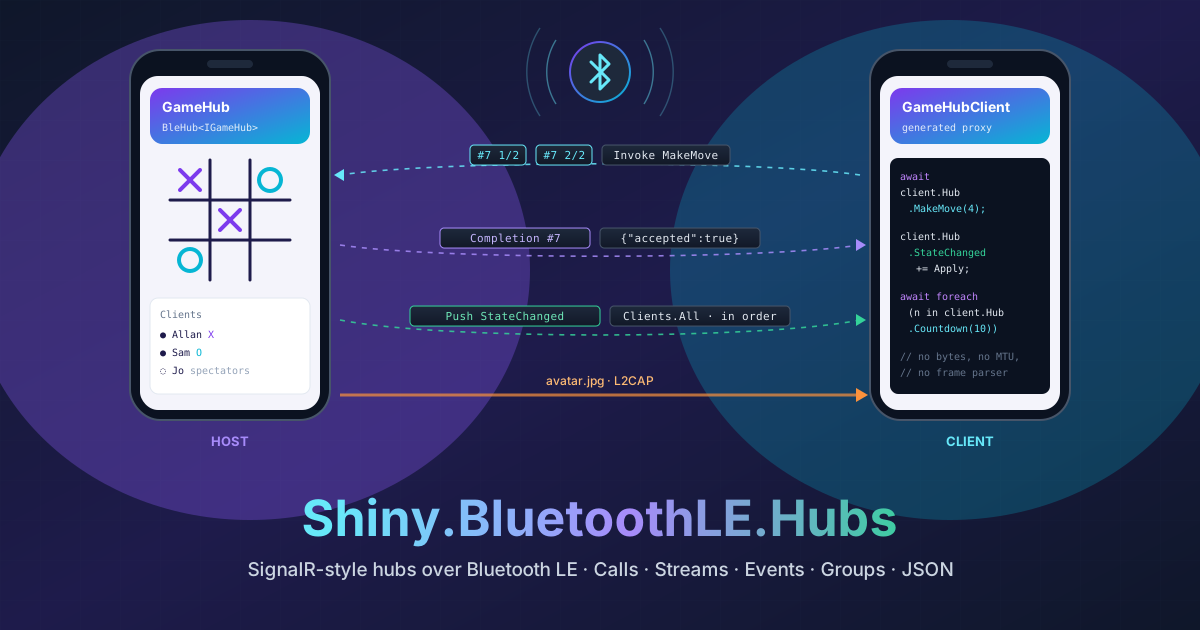
Request/response. Each hub is a single characteristic. The client writes to it and the host notifies
back. Every call gets a message id, and the reply carries it, so many calls can be in flight at once and each finds its
caller. A missing reply becomes a TimeoutException, an exception in the hub becomes a BleHubRemoteException on the
client, and a dropped link fails pending calls with a reason attached. I tried reads for replies first and gave up:
the client can’t tell when a reply is ready, and reads can’t tell two calls apart.
Eventing. A push is its own frame kind, sent by name with its arguments. The host works out who Others or
Group("spectators") means. On the client, pushes go through a channel and are raised one at a time in the order
they were sent, so a state update never overtakes the one before it.
JSON, without the hassle. Every argument, result, stream item and event value is serialized on its own with its
static type, through System.Text.Json source generation by default. You register a JsonSerializerContext on both
sides and that’s it. If JSON isn’t what you want, plug in your own IBleHubSerializer for MessagePack or protobuf.
Streaming the bytes. The serialized message is cut into frames that fit the negotiated MTU (the client asks for 512). Each frame carries a tiny header: version, kind, message id, sequence, first/last flags, and the total length on the first frame. The other side reassembles by message id, with limits on size, time and partial messages, so a misbehaving peer can’t eat your memory. The host sends each message to a client whole, under a lock, so frames never interleave.
Lifecycle. A handshake checks the protocol version and carries the client’s name and properties. The client is
registered and OnConnectedAsync has finished before the handshake is acknowledged, so the first call never
races it. Because iOS can’t drop a central, disconnects are cooperative: the host asks, and the client library leaves.
Every departure has a typed reason on both sides: ClientDisconnect, ClientTimeout, ServerDisconnect,
ServerShutdown or ConnectionFailed. The client says goodbye before it unsubscribes, so the host can finally tell
“they left” from “they walked out of range”. A sweep catches the Android clients that disappear without a word.
Files. GATT runs at a few KB/s. That’s plenty for moves and state, but too slow for a profile photo. So files skip the hub and go over L2CAP, a direct stream between the devices that’s advertised in the handshake:
await client.UploadFile(path, "avatar.jpg");Proof: Tic Tac Toe
The repo ships a .NET MAUI sample. One phone taps Host a game, the next one joins as O, and every phone after that
lands in the spectators group. Moves are hub calls, the board and emotes are pushes, and avatars go over L2CAP. It
runs across iOS and Android in both directions. I test it on two real phones, because simulators have no Bluetooth
and emulators can’t be trusted with it.
What it isn’t
BLE is a slow, short-range link, and a library can’t change that. Large messages are capped at 256 KB by default, there are 8 clients per hub by default, and background hosting on iOS is limited by what Apple allows in the advertisement. This library is for commands, state and events between nearby devices. It isn’t for streaming video.
If you need the same hubs over Wi-Fi too, Shiny.SwitchboardR serves them over the network alongside BLE without any change to your hub or contract.
Go build something
The docs are at shinylib.net/blehubs, and the code, including the Tic Tac Toe sample, is at github.com/shinyorg/blehubs. If you’ve ever stared at a 20-byte MTU and sighed, I’d love to hear what you build with it.