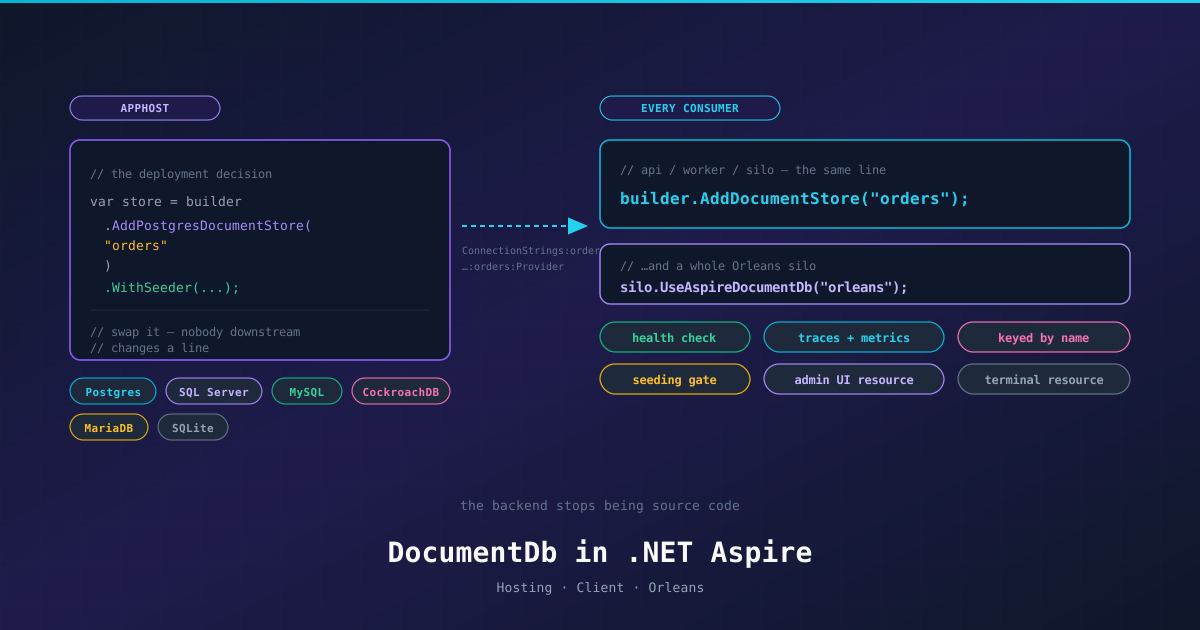
DocumentDB in Aspire
On this page
Here’s a line I’ve written a hundred times and disliked a hundred times:
options.DatabaseProvider = new PostgreSqlDatabaseProvider(connectionString);There’s nothing wrong with it, exactly. But look at what it is. Dev wants SQLite so nobody needs Docker running to debug. CI wants a throwaway container. Production wants managed PostgreSQL. So the one thing that differs between every environment I run in is compiled into my application, and the usual fix is a configuration flag and a switch statement that I write again in every service.
That’s a deployment decision wearing a source-code costume. .NET Aspire is very good at deployment decisions, so I let it have this one.
dotnet add package Shiny.DocumentDb.Aspire.Hosting   # AppHost
dotnet add package Shiny.DocumentDb.Aspire.Client    # service
dotnet add package Shiny.DocumentDb.Aspire.Orleans   # silo
The AppHost picks
var store = builder
    .AddPostgresDocumentStore("orders")     // provisions Postgres, models the store
    .WithSeeder(async (ctx, ct) =>
    {
        // Runs once, after the DB is ready, before anything that depends on it starts.
        // ctx => (StoreName, Provider, ConnectionString)
    });

builder.AddProject<Projects.Api>("api")
    .WithReference(store);
Changing your mind is one line, and nothing downstream changes:
builder.AddSqliteDocumentStore("orders", "orders.db");   // local dev — no container at all
builder.AddSqlServerDocumentStore("orders");
builder.AddMySqlDocumentStore("orders");
Already modelling the database yourself? Wrap it. The provider is auto-detected from the resource:
var pg    = builder.AddPostgres("orders-server").AddDatabase("orders-db");
var store = pg.AsDocumentStore("orders");    // the name has to differ from the DB resource's
CockroachDB and MariaDB are the exception — Aspire has no first-party hosting resource for either, and they
can’t be auto-detected because a plain AddPostgres / AddMySql resource looks exactly like Postgres /
MySQL. Model the container yourself and pass DocumentProviderKind.CockroachDb or MariaDb explicitly to
get the wire-compatible variant.
The service stops caring
builder.AddDocumentStore("orders", configureOptions: o =>
    o.ConfigureDocument<Order>(cfg => cfg.Table = cfg.TypeName));
It’s registered keyed by name, so:
public class OrdersService([FromKeyedServices("orders")] IDocumentStore store)
{
    public Task<Order?> Get(string id) => store.Get<Order>(id);
}
That service has no idea which database it’s talking to, and — this is the part I cared about — it isn’t the
kind of abstraction that falls apart the second you need something real. configureOptions is the whole
DocumentStoreOptions surface. Type maps, JSON contexts, query filters, interceptors, encryption, all of it.
There’s no magic in here
Worth knowing the shape, because you can drive it by hand if you ever need to. The hosting resource implements
IResourceWithConnectionString over its backing database, and WithReference hands the consumer two
things:
| Key | Value |
|---|---|
ConnectionStrings:orders |
the backing database’s connection string |
Shiny:DocumentDb:orders:Provider |
the DocumentProviderKind name |
The client reads both, maps the kind to an IDatabaseProvider, and registers the keyed store. A connection
string with no matching provider key is ignored — so the Redis reference sitting in the same AppHost doesn’t
turn into a junk document store, which is exactly the kind of thing that would otherwise bite you six months
later.
Because the client owns that registration, it also attaches the boilerplate you’d write anyway: a SELECT 1
health check, and the Shiny.DocumentDb meter and ActivitySource into OpenTelemetry. Query metrics and
trace spans show up in the Aspire dashboard without you doing anything. Turn any of it off if you’d rather:
builder.AddDocumentStore("orders", settings =>
{
    settings.MultiTenant         = true;   // shared-table tenancy from a registered ITenantResolver
    settings.PortableSpatial     = true;   // no PostGIS available? use the dependency-free spatial tier
    settings.DisableHealthChecks = true;
});
And when the configuration depends on other registered services — an interceptor with its own dependencies —
there’s a variant that runs with the resolved IServiceProvider:
builder.AddDocumentStore(
    "orders",
    configureServiceOptions: (sp, o) => o.AddInterceptor(sp.GetRequiredService<AuditInterceptor>()));
If you’re on the source-generated typed DocumentContext, it’s the same idea — AddDocumentContextProvider
returns the Action<DocumentStoreOptions> the generated method wants. Each context keys its store by the
context type, so several contexts on different Aspire resources coexist without shadowing each other:
builder.Services.AddOrdersContext(builder.AddDocumentContextProvider("orders"));
builder.Services.AddInvoicesContext(builder.AddDocumentContextProvider("invoices"));
That’s the multi-store story. Two lines.
An entire Orleans silo, one line
A few days ago I wrote about running the whole Orleans persistence stack
— membership, grain storage, reminders, grain directory, streams — on IDocumentStore instead of five
different provider packages. Under Aspire, pointing all of it at the provisioned store looks like this:
builder.AddDocumentStore("orleans");

builder.UseOrleans(silo => silo.UseAspireDocumentDb("orleans"));
That’s grain storage, reminders, clustering and the grain directory, all sharing the one Aspire-managed store — its connection, its health check, its telemetry. On the AppHost the silo is just another consumer:
var store = builder.AddPostgresDocumentStore("orleans");
builder.AddProject<Projects.Silo>("silo").WithReference(store);
No setup scripts, because DocumentDb is schema-free — the membership and storage tables appear on demand. Take a subset with the feature flags if you don’t want all four.
Streams are the one thing deliberately left out of All:
silo.UseAspireDocumentDb("orleans", DocumentDbOrleansFeatures.All | DocumentDbOrleansFeatures.Streams);The reason is a failure mode I didn’t want to ship. Streams need a backend with row-level pessimistic locking
and the silo refuses to start without one. If All included streams, someone’s working SQLite Aspire app
would stop booting because they took a package update. So it’s opt-in, and it will stay opt-in.
The admin UI is a resource too
The admin tool gets modelled like anything else, which means it comes up with your app and every store you referenced is already connected — no connection strings pasted in by hand:
var store = builder.AddPostgresDocumentStore("orders");

builder.AddDocumentDbAdmin(port: 8085)
       .WithReference(store)
       .WaitFor(store);
WithReference is the same contract a service uses, so the tool itself needed no special support. Referenced
stores show up under a from host badge and can’t be edited or deleted from the UI — they’re declared in
the AppHost, so that’s where you change them. The image tag defaults to the hosting package’s own version, so
upgrading the integration brings the matching UI along.
And new in 13.4: Aspire 13.5 added interactive terminal sessions, which was the piece I’d been waiting for. The terminal front end can now be a process rather than a container:
#pragma warning disable ASPIRETERMINAL001
builder.AddDocumentDbAdminTerminal()
       .WithReference(store)
       .WithStartupProfile(store)
       .WaitFor(store);
aspire config set features.terminalCommandsEnabled true
aspire terminal attach documentdb-terminalWithStartupProfile passes --profile, so attaching drops you straight onto that database instead of the
connection list. Locally it replaces the container outright, and it’s the only one of the two that can open a
file-backed store — SQLite, SQLCipher, DuckDB — without a bind mount, which for a local dev loop is the
whole ballgame. It does not deploy: terminal sessions are a dev-loop feature, so the resource is excluded from
the manifest and anything you publish still wants AddDocumentDbAdmin.
That does move the hosting package’s Aspire floor to 13.5, since WithTerminal doesn’t exist before it.
One safety note I’ll repeat as often as it takes: both front ends expose a full editor and an open SQL prompt
over every store you reference. Chain .WithReadOnly() for anything beyond a local AppHost, .WithSecretKey(...)
so saved profiles aren’t protected by a key generated next to them, and if you’re publishing a public demo,
.WithoutAi() — which removes the assistant entirely rather than hiding it, so nobody is ever invited to paste
their own API key into a database browser they don’t control.
What it deliberately doesn’t do
This is a server-tier convenience and I want to be clear about that. It does nothing for DocumentDb’s offline-first side — SQLite on a phone, LiteDB, IndexedDB in the browser — because none of those ever meet an AppHost. And it covers the relational providers plus SQLite: PostgreSQL, CockroachDB, SQL Server, MySQL, MariaDB, SQLite. MongoDB and Cosmos need different client-registration paths and are a follow-up.
Inside that scope, though, I get the thing I wanted. The backend and the seed strategy live in the AppHost where deployment decisions belong, and every service that touches the store is one line that doesn’t know or care which one got picked.