Shiny Health 2.0 — The Ultimate Cross-Platform Health Library
On this page
Here’s something that should be simple but absolutely is not: reading a person’s step count on both an iPhone and an Android phone.
On iOS you reach into HealthKit — HKQuantityType, HKStatisticsCollectionQuery, HKCategorySample, HKCorrelation, and a permission model that won’t even tell you if the user said no. On Android you reach into Health Connect — Kotlin record types, suspend functions you have to bridge from C#, aggregate metrics for some data and not others, and a separate runtime permission string for every single record type. Two completely different mental models for the same question: how many steps?
I got tired of writing that glue in every app. So a while back I built Shiny Health — one IHealthService that speaks to both. Today I’m shipping 2.0, and it’s a big jump: 30+ data types, first-class support for the messy non-numeric stuff, and — the part I’m most excited about — a package that turns your health data into tools an LLM agent can call.
This is the first time I’ve actually blogged about the library, so let me give you the whole tour.
The shape of it
Register it once:
builder.Services.AddHealthIntegration();Then inject IHealthService, ask for permission, and query. Everything’s async, cancellable, and AOT-friendly — on Android I bridge Kotlin coroutines through a hand-rolled IContinuation so there’s zero reflection.
await health.RequestPermissions(DataType.StepCount, DataType.HeartRate);

var end = DateTimeOffset.Now;
var start = end.AddDays(-1);

var steps = (await health.GetStepCounts(start, end, Interval.Hours)).Sum(x => x.Value);
var hr = (await health.GetAverageHeartRate(start, end, Interval.Hours)).Average(x => x.Value);
Numeric metrics come back time-bucketed — pick Minutes, Hours, or Days. Cumulative things (steps, calories, distance) you sum; point-in-time things (heart rate, weight) you average. That’s the whole learning curve.
What 2.0 actually adds
The catalog went from a dozen metrics to 30+. Activity (steps, distance, active & basal energy, floors, wheelchair pushes, speed, power), heart (average, resting, and variability), body (weight, height, body fat, lean body mass), vitals (blood pressure, SpO₂, blood glucose, body & basal temperature, respiratory rate, VO2 max), and lifestyle (sleep, hydration). Each numeric metric has its own Get… method plus read, write, and real-time observe.
But the more interesting work in 2.0 was the data that isn’t a single number. Blood pressure has two values, so it gets its own result type. And an entire category of health data is categorical and event-based — so I gave each its own record instead of pretending it’s a double:
var flow = await health.GetMenstruationFlow(start, end);     // None / Light / Medium / Heavy
var ovulation = await health.GetOvulationTests(start, end);  // Positive / Negative / High / Inconclusive
var mucus = await health.GetCervicalMucus(start, end);
var spotting = await health.GetIntermenstrualBleeding(start, end);

var workouts = await health.GetWorkouts(start, end);
foreach (var w in workouts)
    Console.WriteLine($"{w.Workout}: {w.TotalEnergyKilocalories} kcal");

await health.Write(new NutritionResult(
    DateTimeOffset.Now, DateTimeOffset.Now,
    Meal: MealType.Lunch, Name: "Chicken & rice",
    EnergyKilocalories: 550, ProteinGrams: 40
));
Workouts map 21 activity types that exist on both platforms; anything exotic reads back as Other. Writing is symmetric — every numeric metric goes in through NumericHealthResult, and permissions are granular (Read, Write, or ReadWrite, per-metric if you want).
And if you want to react to data as it lands, Observe streams it:
await foreach (var r in health.Observe(DataType.HeartRate, cancelToken: cts.Token))
    if (r is NumericHealthResult n) Console.WriteLine($"❤️ {n.Value} bpm");
Push-based on iOS, change-token polling on Android — same IAsyncEnumerable<HealthResult> either way.
The fun part: give your agent a body of data
Here’s what I really wanted to build. Once you have a clean, unified health API, exposing it to an LLM is the obvious next move — “How did I sleep last week?”, “Log my morning run”, “What’s my average resting heart rate this month?” should just work.
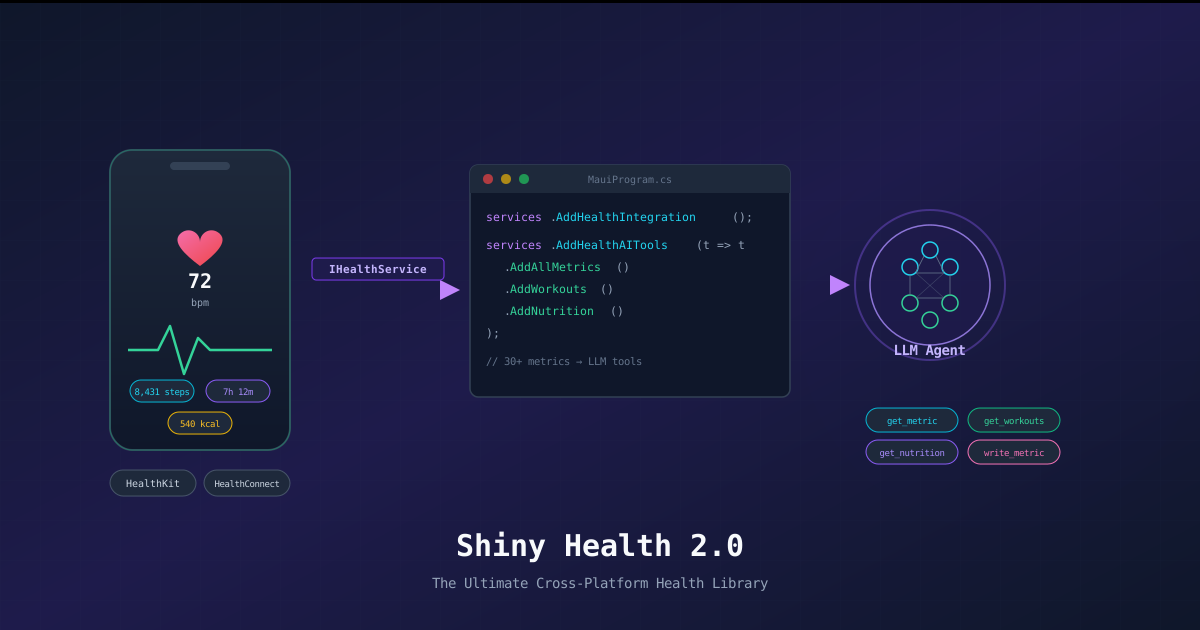
So Shiny.Health.Extensions.AI turns IHealthService into Microsoft.Extensions.AI tool functions. I deliberately did not generate one tool per metric — 25 near-identical tools is how you confuse a model. Instead there’s a single get_health_metric tool with a metric enum, and the enum only contains the metrics you opted in. Read-only by default; write is opt-in per area.
builder.Services.AddHealthAITools(tools => tools
    .AddAllMetrics()                                          // read everything numeric
    .AddMetric(DataType.Weight, HealthAICapabilities.ReadWrite)
    .AddBloodPressure(HealthAICapabilities.ReadWrite)
    .AddCycleTracking()
    .AddWorkouts(HealthAICapabilities.ReadWrite)
    .AddNutrition()
);

var tools = sp.GetRequiredService<HealthAITools>().Tools;
var response = await chatClient.GetResponseAsync(messages, new ChatOptions { Tools = [.. tools] });
That’s it. The model can now read and (where you allow it) write health data through natural language. The whole package is AOT-compatible — schemas are hand-built and results come back as JsonNode, so there’s no reflection in the tool path.
I’m not going to lie to you about the platforms
A unified API is great right up until it papers over a real difference and burns you. So where the platforms genuinely disagree, Shiny Health surfaces it instead of hiding it:
- Heart rate variability is SDNN on iOS and RMSSD on Android. Both in milliseconds, both “HRV”, but computed differently — don’t compare them across platforms.
- Speed and Power are generic on Health Connect; HealthKit has no generic versions, so
Speedmaps to walking speed andPowerto cycling power. - A workout’s energy and distance are
nullon Android read, because Health Connect stores those as separate records from the session.
Those caveats are in the XML docs and the platform notes — I’d rather you know up front than file a bug.
Try it
dotnet add package Shiny.Health
dotnet add package Shiny.Health.Extensions.AI   # optional, for the agent stuff
Docs are at shinylib.net/health, source is on GitHub. One interface, both platforms, 30+ metrics — and now an agent that can read and write all of them. Go build something healthy.