Introducing Shiny.AiConversation — Text, Voice & Wake Word in One Service
On this page
Early Beta — This library is in active development. APIs may change, and some features are still being stabilized. Feedback and bug reports are very welcome, but don’t ship it to production just yet.
Building an AI-powered app today means stitching together a chat client, speech recognition, text-to-speech, audio playback, message persistence, and state management — across platforms, with proper lifecycle handling. That’s a lot of plumbing before you write your first prompt.
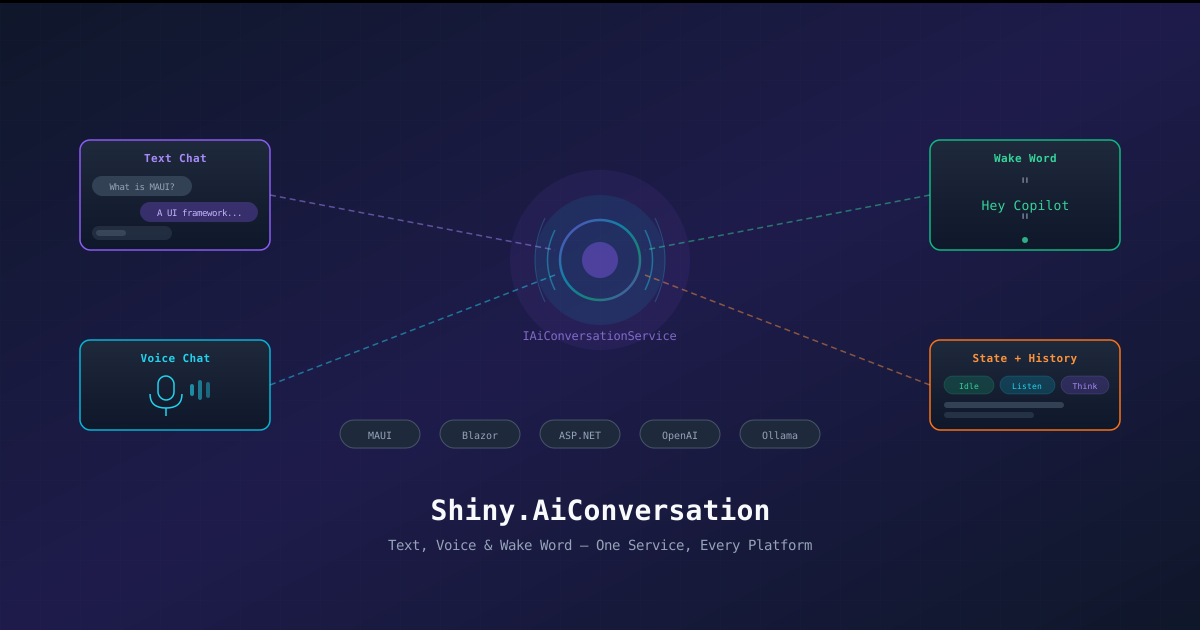
Shiny.AiConversation wraps all of that into a single IAiConversationService interface. Text chat, voice chat, hands-free wake word activation, configurable audio feedback, and persistent chat history — registered with one DI call, consumed through one service.
The Problem
Every AI chat app ends up building the same infrastructure:
- An authenticated chat client that handles token refresh
- Speech-to-text so users can talk instead of type
- Text-to-speech so the AI can respond out loud
- Sound effects for state transitions (thinking, responding, error)
- A wake word listener for hands-free mode
- Message persistence for chat history
- State management so the UI knows what’s happening
- Thread safety so nothing blows up
Each of these is a separate library, a separate abstraction, and a separate set of platform quirks. You spend weeks on infrastructure before you ship a single feature.
The Solution
// Register your chat client in DI
builder.Services.AddChatClient(new OpenAIClient("your-api-key").GetChatClient("gpt-4o").AsIChatClient());

builder.Services.AddShinyAiConversation(opts =>
{
    opts.SetMessageStore<MyMessageStore>(); // optional
});
That’s it. The service registers IAiConversationService with all the wiring — speech services from Shiny.Speech, chat completions from Microsoft.Extensions.AI, audio playback, time provider, and optional message persistence. The default IChatClientProvider resolves IChatClient straight from DI, so for most apps you just register your chat client and go. For advanced scenarios (on-demand auth, token refresh), you can still implement IChatClientProvider directly.
What You Can Do
Text Chat
The simplest path. Send a message, get a streaming response:
aiService.AiResponded += response =>
    Console.WriteLine($"AI: {response.Message}");

await aiService.TalkTo("What is .NET MAUI?", cancellationToken);
The service handles the full lifecycle — acquires the chat client, prepends system prompts, streams the response, stores both messages if a message store is configured, fires the event, and manages state transitions throughout.
Voice Chat (Push-to-Talk)
One method call captures speech and sends it to the AI:
await aiService.ListenAndTalk(cancellationToken);The service activates speech-to-text, waits for the user to stop speaking, sends the transcribed text through TalkTo(), and optionally reads the response aloud via text-to-speech.
Hands-Free Wake Word
This is the “Hey Siri” experience:
await aiService.StartWakeWord("Hey Copilot");The service enters a continuous loop: listen for the wake phrase, capture the utterance that follows, send it to the AI, loop back. The user never touches the screen. Call StopWakeWord() when you’re done.
Four Acknowledgement Modes
Control how the AI delivers responses:
| Mode | What Happens |
|---|---|
None |
Silent — text only, delivered via the AiResponded event |
AudioBlip |
Short sound effects at each state transition |
LessWordy |
Text-to-speech with a “be concise” system prompt |
Full |
Full text-to-speech of the complete response |
Sound effects are driven by string file names and a SoundResolver callback — the library stays platform-agnostic while you provide the stream:
aiService.SoundResolver = name => FileSystem.OpenAppPackageFileAsync(name);
aiService.ThinkSound = "think.mp3";
aiService.OkSound = "ok.mp3";
Chat History with AI Self-Lookup
Register an IMessageStore and every message is automatically persisted. But the interesting part is the AI chat lookup tool — it’s an AITool that lets the AI search its own conversation history:
“What did we talk about yesterday?” “Find the recipe you gave me last week.”
The tool is registered automatically when you call SetMessageStore(). The AI gets search parameters (text, date range, limit) and queries your store directly.
Observable State
The service exposes its current state and fires events:
aiService.StateChanged += () =>
{
    // Status: Idle, Listening, Thinking, Responding
    UpdateUI(aiService.Status);
};
This is what powers the “Aura” visualization in the sample app — a pulsing orb that changes color based on what the AI is doing.
Bring Your Own Backend
The library doesn’t care which AI you use. By default, it resolves IChatClient from DI — just register one and you’re done. For advanced auth scenarios, implement IChatClientProvider to return any IChatClient from Microsoft.Extensions.AI:
- OpenAI —
new OpenAIClient(apiKey).GetChatClient("gpt-4o").AsIChatClient() - GitHub Copilot — OAuth device code flow with Copilot API token exchange
- Azure OpenAI — Managed identity or API key
- Ollama — Local model, no auth needed
- Anything else — If it implements
IChatClient, it works
The sample apps include a complete GitHub Copilot implementation with device code flow, token caching, automatic re-authentication, and the custom HTTP headers the Copilot API requires.
Cross-Platform from Day One
The library targets plain net10.0 — no MAUI dependency in the library itself. Shiny.Speech handles the platform abstraction for speech and audio, so the same IAiConversationService works on:
- MAUI — Android, iOS, Windows, Mac Catalyst
- Blazor — Server-side and WebAssembly (speech via Web Audio API)
Two sample apps prove it: a full MAUI sample with chat, settings, and an animated aura visualization, plus a Blazor Server sample with the same features translated to Razor components and CSS animations.
AOT Compatible
The library is built with IsAotCompatible=true. Generic type parameters on SetChatClientProvider<T>() and SetMessageStore<T>() carry [DynamicallyAccessedMembers] attributes so the trimmer knows what to keep. No reflection surprises at runtime.
Get Started
dotnet add package Shiny.AiConversationThe library is MIT licensed and open source. I’d love to hear what you build with it.