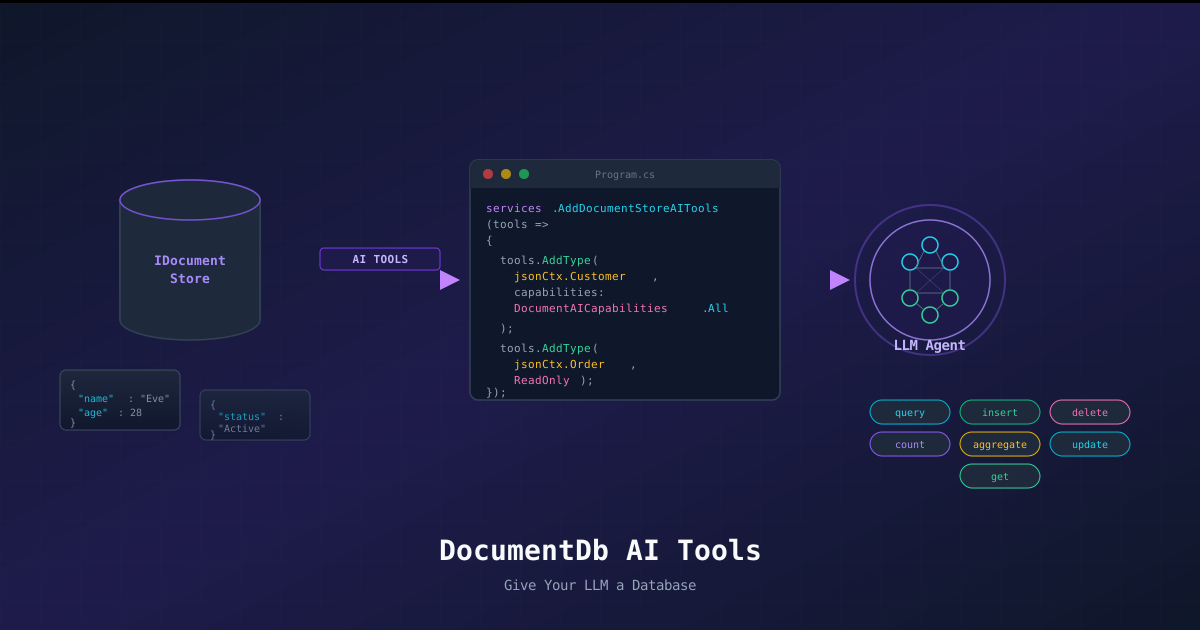
DocumentDb AI Tools — Give Your LLM a Database
On this page
You have a document store with customers, orders, and products. Now you want an LLM agent to answer questions about that data — or even modify it — without writing custom glue code for every operation. Shiny.DocumentDb.Extensions.AI makes that a one-time setup.
What It Does
The new Shiny.DocumentDb.Extensions.AI package generates Microsoft.Extensions.AI tool functions from your registered document types. Each type can expose up to seven operations: get by ID, query with structured filters, count, aggregate (sum/min/max/avg), insert, update, and delete.
You control everything: which types are visible to the LLM, which operations are allowed, which fields are exposed, and how many results a single query can return.
Setup in 30 Seconds
var jsonContext = new AppJsonContext(new JsonSerializerOptions
{
    PropertyNamingPolicy = JsonNamingPolicy.CamelCase
});

services.AddDocumentStore(opts =>
{
    opts.DatabaseProvider = new SqliteDatabaseProvider("Data Source=mydata.db");
    opts.JsonSerializerOptions = jsonContext.Options;
});

services.AddDocumentStoreAITools(tools =>
{
    tools.AddType(
        jsonContext.Customer,
        capabilities: DocumentAICapabilities.All,
        configure: b => b
            .Description("Customer records")
            .Property(c => c.Status, "Active, Inactive, or Suspended")
            .IgnoreProperties(c => c.PasswordHash)
            .MaxPageSize(50)
    );

    tools.AddType(
        jsonContext.Order,
        capabilities: DocumentAICapabilities.ReadOnly
    );
});
That registers 11 tools: 7 for Customer (full CRUD) and 4 for Order (read-only). Types not registered are invisible to the LLM.
Structured Filters
The query, count, and aggregate tools accept a structured filter that supports boolean combinators — and, or, not — and leaf comparisons with operators like eq, gt, contains, startsWith, and in. The library translates these JSON filter objects into LINQ expressions against the document store, so they work across all providers (SQLite, MySQL, SQL Server, PostgreSQL).
When an LLM asks “show me customers older than 30 in Portland”, it constructs:
{
  "and": [
    { "field": "age", "op": "gt", "value": 30 },
    { "field": "city", "op": "eq", "value": "Portland" }
  ]
}
This becomes store.Query<Customer>().Where(c => c.Age > 30 && c.City == "Portland") under the hood.
Field Visibility
Not every field should be visible to an LLM agent. Use AllowProperties to create an allowlist or IgnoreProperties to hide specific fields:
// Only expose these fields
b.AllowProperties(c => c.Id, c => c.Name, c => c.Email);

// Or hide sensitive fields
b.IgnoreProperties(c => c.PasswordHash, c => c.InternalNotes);
Hidden fields don’t appear in the tool’s JSON schema, so the LLM doesn’t know they exist and can’t filter on them.
Capability Flags
The DocumentAICapabilities flags enum gives you precise control:
// Read-only: get, query, count, aggregate
tools.AddType(jsonContext.AuditLog, capabilities: DocumentAICapabilities.ReadOnly);

// Full CRUD
tools.AddType(jsonContext.Customer, capabilities: DocumentAICapabilities.All);

// Just query and count
tools.AddType(jsonContext.Config, capabilities: DocumentAICapabilities.Query | DocumentAICapabilities.Count);
AOT-Safe
All tool schemas and serialization use JsonTypeInfo<T> from your source-generated JSON context. No reflection at runtime. The filter translator builds expression trees programmatically — it never calls Expression.Compile() — so the existing JSON-extract SQL translator handles AOT-safe code generation.
Try the Copilot Sample
The repository includes a Sample.CopilotConsole project that authenticates with GitHub Copilot and starts an interactive chat session. The LLM can query customers, create orders, compute aggregates — all through the registered AI tools. Try it:
cd samples/Sample.CopilotConsole
dotnet run
Then ask things like “How many customers do we have?”, “Show me all shipped orders”, or “Add a customer named Eve, age 28”.
Getting Started
Check the full documentation for the API reference and the release notes for the complete v4.0 changelog.